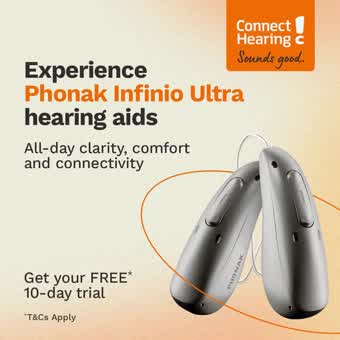
Connect Hearing118 days
full ad · 0:24
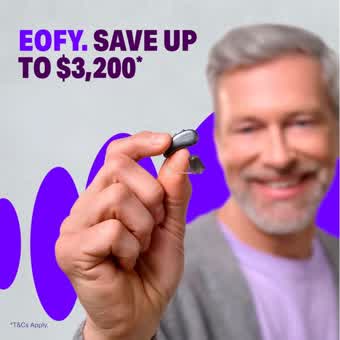
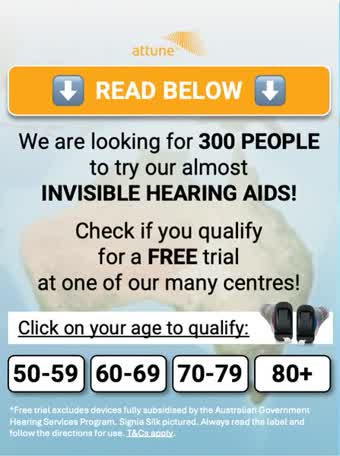
🗣️ WANTED: People aged 55+ to try this revolutionary and almost invisible hearing aid FREE for 10 days!
Swept from 200+ live ads across 20+ Australian hearing advertisers, boiled down to seven plays. Watch the winners, then shoot the green Clarion version under each one.
Every ad has a code. P4-C means play 4, ad C — counting left to right, top to bottom. Each play's green Clarion recipe is P4-RX, and the play itself is P4. Always use the code, never the brand name — several advertisers appear in more than one play, and two different Auditorey ads sit in two different plays.
Click a code once and it selects itself, ready to copy. The small grey number beside it is the tail of Meta's own Library ID — click that and it opens the live ad in the Meta Ad Library, so you can check it for yourself rather than taking this page's word for it.
To send someone straight to one card, add the code to the page address:
…#P4-C. Codes are fixed — they will not move if this board is updated.
The winning ads don't sell a hearing aid. They offer a chance to be selected for one — and four advertisers — from arms of the world's biggest hearing retailers to anonymous affiliate pages — are running that play right now.
Break-even is a $1,218 cost per sale. Every Clarion ad that has ever made a sale made it profitably — even the worst one cleared $309.
| Advertised price | $1,618 |
| Discount applied at checkout | −$100 |
| Kit landed — aid, custom packaging, bonuses | −$300 |
| Gross profit per sale | $1,218 |
Against that: the best Clarion ad cost $386 a sale — $832 profit each. The worst cost $909 — still $309 profit. Cost per sale was never the problem. Volume was. The actual leak is the $2,319 that went to three ads which produced nothing at all, so the discipline is to kill a non-converter early and put the money behind anything that sells.
Re-swept 19 August. This market moves faster than the board did.
| Specsavers | Woke up. Recorded on 13 Aug as zero live hearing ads — incumbent asleep. Now 13+ live hearing ads, the oldest running since 28 February — 172 days. See SPECS below; this is the most important change in the market. watch their longest-runner ↗ |
| Amplifon group | 81 + 70 → 490 under Amplifon, 290 under EarPros = 780 live ads, more than half of all live hearing advertising counted. Both are hearing-only businesses, so none of it is spillover. watch Amplifon ↗ |
| TruHear | 7 live ads → ~320. It is now the second-biggest advertiser in the market — and it runs Clarion's price argument. watch TruHear ↗ |
| Country Hearing Care | The long-runner is 829 days and there are three of them, not one. But all five of their live ads now say Bendigo — the Echuca and Mildura variants have died. Suburb-swap proof moves to Attune below. watch the 829-day ad ↗ |
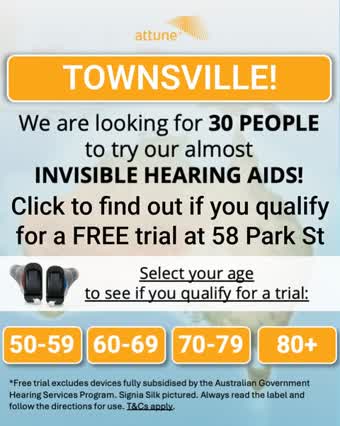
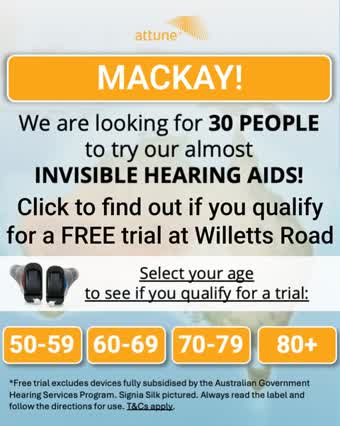
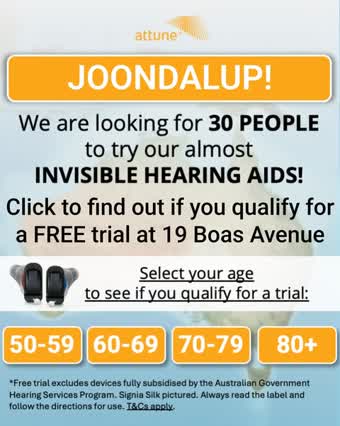
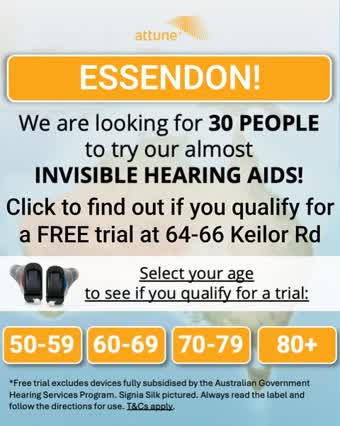
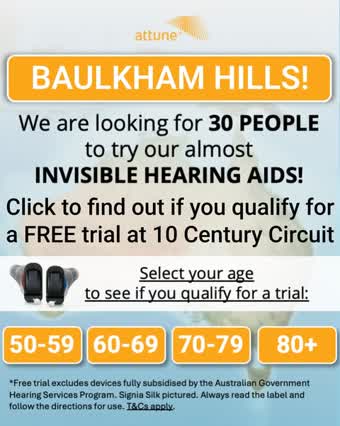
| Attune | The town swap is bigger than recorded: 26 named towns across QLD, WA, SA, VIC and NSW off one creative — Townsville, Mackay, Bundaberg, Ipswich, Hervey Bay, Rockhampton, Gladstone, Maryborough, Tewantin, Kawana, Cleveland, Kenmore, Springwood, Mount Ommaney, Caboolture, Joondalup, Jandakot, Morphett Vale, Frankston, Essendon, Hoppers Crossing, Mornington, Baulkham Hills, Coffs Harbour, Nambucca, Wesley. watch Townsville ↗ |
| Bloom | Dropped 17 video ads on a single day (15 May), all still live. The opposite tactic to the drip — flood the auction with one creative family in one hit. watch Bloom ↗ |
| Still reloading | Melissa Thompson launched two fresh price-teardown advertorials on 12 August. That wave is not slowing. Widex is live at 293 days and was missed entirely last time. watch the 12 Aug advertorial ↗ watch Widex ↗ |
| Market size | 1,759 live ads across 10 advertisers, and >50,000 inactive against ~3,800 active for "hearing aids" in Australia — the dead outnumber the living roughly 13 to 1. |
Don't sell a hearing aid. Offer a chance to be selected for one.
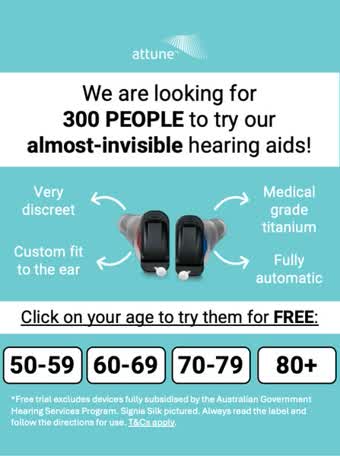
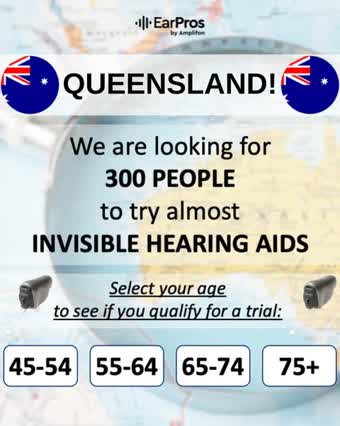
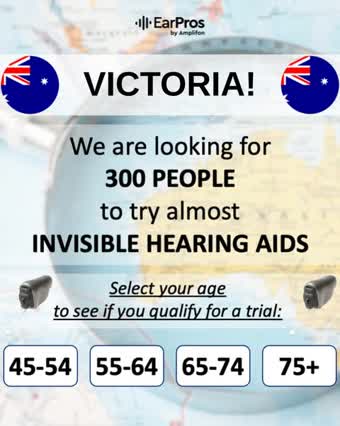
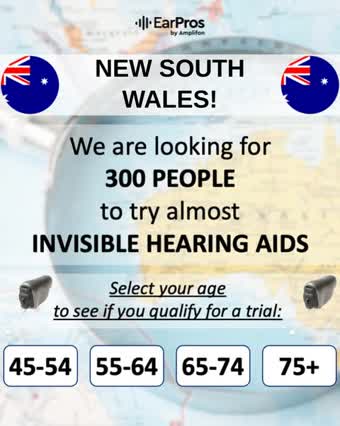
Everyone runs this script: a 598-day anonymous lead-gen page, Sonova-owned Connect Hearing, Attune across 26 towns — and EarPros, Amplifon's lead-gen brand, has run the state-level version for 201 days — 40 days longer than the longest-lived ad in our 27-ad graveyard sample ever managed. Attune's hard quota — 300 people nationally, 30 per town — is the sharpest detail.
 still ad
 still ad
“WANTED: Australians over 60 to trial this hearing aid at home for 90 days. The catch? There isn't one — no application, no shortlist, every order gets the trial. $1,618 instead of [CLINIC QUOTE], backed by a 3-year warranty.”
Test: The WANTED casting-style opener vs a plain 'Try it at home for 90 days, $1,618' opener on the identical body — judged on cost per purchase, not clicks.
One asset. One word changed. Run it forever.
Attune runs one creative across 26 named towns in five states — the roster is listed under MOVED above. Meanwhile Country Hearing Care has run the same Bendigo video for 829 days, in triplicate, and it sells nothing at all: no product, no price, no offer, no urgency — just six symptoms you check against yourself and a booking link. Its Echuca and Mildura variants have since died; all five of its live ads now say Bendigo. The longest-running ad in this market is the one that stopped trying to sell. Shoot once, caption fifty times.
 still ad
 still ad
“[TOWN]! Before you drive to a hearing clinic and pay [CLINIC QUOTE], have a look at this. $1,618, posted straight to your door — no clinic, no appointment, and 90 days at home to make up your own mind.”
Test: Run the [TOWN]-swapped open against one generic national open ('Regional Australia!') on cost per purchase, to prove the geo swap itself earns the extra ad-set overhead before scaling it across the town list.
The best offer in this category isn't cheap. It's free to them.
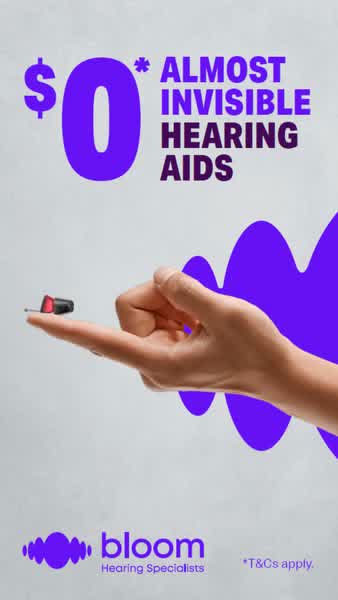
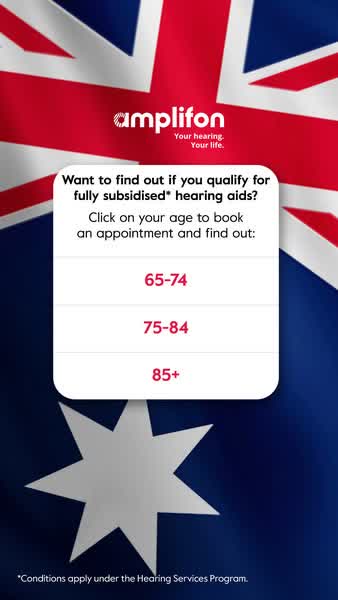
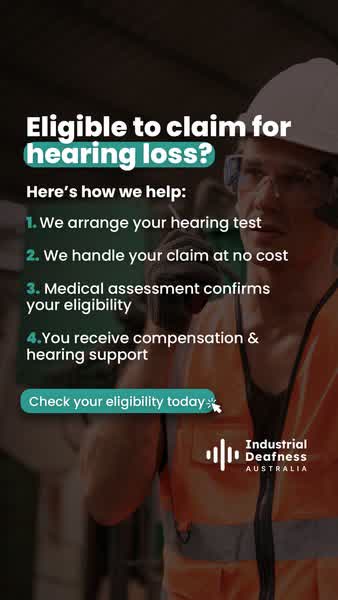
Bloom's "$0 out-of-pocket if you qualify" welds the free offer to the eligibility gate in one line — and Amplifon runs 490 live Australian ads, with another 290 under its EarPros lead-gen brand: 780 between them, over half of all live hearing advertising we counted, leading with the same $0 HSP offer. IHS sells the compensation payout, not the aid.
 still ad
 still ad
“Hearing aids aren't cheap — and we're not going to pretend otherwise. What we can do: $1,618 instead of the clinic's [CLINIC QUOTE], and 90 days to change your mind. Don't suit you? Send them back, money back.”
Test: Test only the first three seconds: risk-reversal lead ("90 days to change your mind") versus price-gap lead ("[CLINIC QUOTE] versus $1,618"), identical body and shots.
Don't claim the price gap. Test it, and report back.
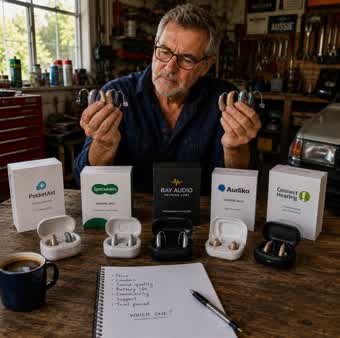
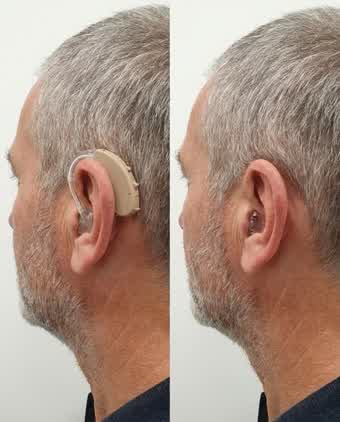
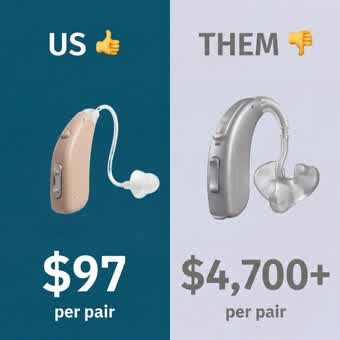
Clarion's argument, already written by its direct rivals. Split-tested advertorials ($6,495/$299 vs A$8,770/A$400), a fresh adult-child wave waving a real competitor invoice, and TruHear — an online-only seller attacking clinic prices head-on, now running roughly 320 live ads, the second-biggest advertiser in the market. The DTC pack runs one playbook: price attack, persona advertorials, and long video sales letters like Coniler's 202-second ad below. Clarion's edge is running the same story as a real brand with a real face. Needs no studio.
 still ad
 still ad
 still ad
 still ad
 still ad
“This is a genuine quote from an Australian hearing clinic — [CLINIC QUOTE] for a pair of hearing aids. This pair is $1,618. I'm going to show you exactly what turns up in the box — and you get 90 days to decide for yourself.”
Test: A/B the hook's lead: open on the clinic quote and the price gap versus open on the 90-day trial ("you get 90 days to decide"), judged on cost per purchase, not clicks.
Make a national ad read like a local council notice.
"If you live in these post codes" turns a national ad into a letter from the council — and eligible implies someone else is paying. The news-headline cousin ("Aussie Seniors Snap Up…") tells readers their peers have already decided.
 still ad
 still ad
“The only eligibility check for these hearing aids? An Australian letterbox. No clinic, no waiting room — $1,618 delivered to your door, 90 days at home to decide, instead of the [CLINIC QUOTE] you'll hear at a clinic.”
Test: A/B the opening line only, same body and end card: the postcode-flip hook ("the only eligibility check is an Australian letterbox") versus a price-anchor hook ("Quoted [CLINIC QUOTE] at a clinic? Watch this before you pay it").
Name a symptom they'll admit to. Never name the condition.
Audika's hook ran across a dozen ads in a single query and never says deaf, loss or old — it names a behaviour you catch yourself doing. And once a real customer exists, "Meet John" is the follow-up: sell being back in the conversation, never sound quality.
“If "sorry, say that again?" has become your catchphrase — or the telly's crept up to a volume the neighbours can vouch for — you don't need a clinic appointment to do something about it. Clarion hearing aids come straight to your door: $1,618 instead of the [CLINIC QUOTE] a clinic will quote you, with a 90-day trial and a 3-year warranty.”
Test: Swap only the first three seconds: hook A names the "say that again?" habit versus hook B naming the loud-telly habit, identical body and offer, and let spend follow whichever behaviour more 60+ Australians recognise as their own.
Know the one fight you cannot win.
Hearing Australia is government-owned — no private brand out-credentials it. Clarion competes on price, access and honesty, never clinical authority.
“The clinics have the experts — we're not going to pretend we do. What we've got is a hearing aid for $1,618 instead of [CLINIC QUOTE], posted to your door, 90 days to try it at home, 3-year warranty.”
Test: Test the hook order: concession-first ("The clinics have the experts…") versus price-first ("[CLINIC QUOTE] at a clinic. $1,618 here.") with identical shots and close.
They are running Clarion's argument, with 900 stores behind it.
"Our everyday low prices on hearing aids are upfront, so you'll know what you're paying from the start." → View our prices online watch it ↗
"Don't get your ears ripped off on hearing aids, we've got you covered at Specsavers Audiology" → Compare your pair! watch it ↗
"Book a free appointment with a Specsavers hearing expert today — $0 government-funded hearing aids could be yours! T&Cs apply." watch it ↗
That is price transparency, the anti-ripoff line, and someone-else-pays — the three angles this board recommends for Clarion — from a brand with a national store network and decades of trust.
Note which one is winning. Their longest-surviving hearing ad, at 172 days and running in three copies, is the plain price-transparency one. Not the $0 offer. In this market transparency outlives discount — write yours accordingly.
Clarion cannot out-cheap or out-transparent Specsavers. That fight is lost before it starts.
Book an appointment. Come in. Compare your pair. They need you inside a store — that is their model and their cost base. So the ground Clarion can own outright is the ground they structurally cannot touch: no appointment, no clinic, no waiting room, posted to your door, and 90 days to decide in your own lounge room instead of a sound booth.
And the one thing nobody in this market has. TruHear is faceless. Specsavers is a chain. Amplifon and Audika are corporate. Auditorey and the persona pages are anonymous. Not one advertiser we found puts a real, named Australian owner on camera. That is Clarion's only uncontested ground.
Specsavers makes you come to them. Clarion comes to you.
Every hook below is live in Australia today. Copy the mechanic, never the words.
Amplifon runs the casting call at three geographic tiers, and the quota shrinks with the geography. That proportionality is the whole trick — a national intake of 300 is plausible, and so is 25 in Mildura. Use 300 for Mildura and it reads as fake.
| National | "WE ARE LOOKING for 300 people to try our NEWEST hearing aid Ampli-mini. Designed to be invisible. Natural sound." |
| State | "WANTED: 100 people over 45 from WESTERN AUSTRALIA for our 2026 Hearing Aid Program" — also run for QLD, SA and TAS. |
| Town | "WANTED: 25 people from MILDURA → Hurry! Limited spots available to try this device" — also Melbourne, Adelaide, Ballarat, Kwinana, Mandurah. |
Note the second device too: naming a program. "Our 2026 Hearing Aid Program" invents an institution, and an institution can have an intake, a quota and a closing date. Attune does the same with 30 per town, 300 nationally. watch the EarPros state version ↗
"Bendigo! Think you might have a hearing problem? … don't suffer in silence, we're here to help. What are the signs of hearing loss? → It sounds like others mumble → Finding it difficult to hear in background noise → Trouble hearing the TV, the phone or videocalls → Asking friends and family to repeat themselves all the time → Difficulty hearing women and children's voices → Ringing or other noises in your ears"
The strongest line in Australian hearing advertising is "difficulty hearing women and children's voices". It is clinically true — high frequencies go first — and it quietly tells a 65-year-old they cannot hear their grandchildren. It sells nothing and outlives everything. watch it ↗
Specsavers, 172 days, their longest-running hearing ad: "Our everyday low prices on hearing aids are upfront, so you'll know what you're paying from the start." → View our prices online
TruHear, ~320 live ads: "Here's 5 reasons why you SHOULD stop paying THOUSANDS for your Hearing Aids — TruHear offers the SAME premium sound and performance for a fraction of the price… See why over 10,000 people switched and saved big."
The advertorial split test, run from two different pages with two different numbers: "I put a A$8,770 hearing aid in my left ear and a A$400 one in my right. Then on Friday night, I headed down to the local RSL club." / the same script at $6,495 vs $299.
The adult-child version: "My dad showed me the National Hearing Care invoice last Tuesday. $4,800 for two hearing aids. He'd been saving for eight months."
Transparency outlives discount. Specsavers' plain "here are our prices" ad has run 172 days; their $0 offer ads are all newer. Devices worth taking: the listicle frame, SAME in capitals as a parity claim, a hard number for social proof, and testing the price gap rather than asserting it.
Audika: "Find yourself saying, 'Say that again' again and again?"
Coniler: "Are you or a loved one struggling to hear conversations clearly?" — one hook, two buyers.
Amplifon: "Feel connected again. Everyday moments can become clearer." · "Don't miss life's important moments."
Auditorey: "Australian Pensioners Are Eligible For Invisible Hearing Aids (If You Live In These Post Codes)" · "See If You Qualify in 60 secs"
Nobody successful says deaf, hearing loss or old in the hook. They name a moment you have already lived. And note Amplifon's proof stack — "350+ clinics nation-wide, open 7 days" — scale as reassurance, which is exactly the claim Clarion should not try to match.
26 more live creatives from the same sweep. Longest-running first.
Everything above is the argument; this is the evidence behind it. Every video on this page plays in place, full length, nothing trimmed — hit play on any card. Every card is live today, captioned with how long it has survived, and opens in Meta's own Ad Library. Look at the top row first: those are the ads that have outlived everything else in this market.
Australia sells appointments. America sells hearing aids. Clarion sells hearing aids.
This is the correct comparison set, and the board did not have it. Almost every Australian advertiser above is really selling a clinic visit — book an appointment, check your eligibility, get selected for a trial. Clarion does none of that. It sells a product online, at a named price, in one click. So the advertisers worth studying are the US direct-to-consumer brands who do the same thing — and whose ads have survived 296 and 370 days doing it. Swept from the US Ad Library, 19 Aug 2026, active only.
Modern Hearing: "Everything you're missing costs 34 cents a day to get back. Here's the math. Let me show you some numbers. Average cost of a Starbucks coffee: $5.50…"
Clarion's version is already true and needs no invention: $1,518 across the 3-year warranty is about $1.39 a day — roughly a third of a takeaway coffee. Against a $5,000 clinic pair it is the most disarming way to put the number on screen. It also survives compliance, because it is arithmetic on your own real price and your own real warranty.
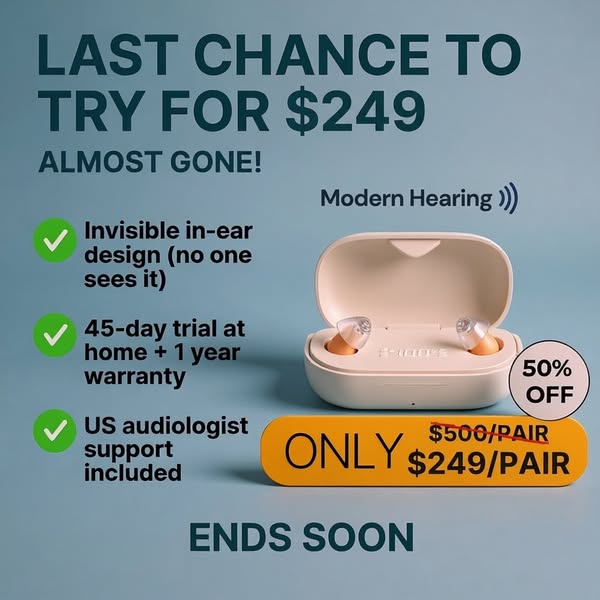
Modern Hearing, running in multiple copies since May: "Miracle-Ear: $4,500. Costco: $1,500. Amazon: $50. Modern Hearing: $249. I spent three weeks finding out why those numbers are so different."
Four numbers, one line, and the reader does the positioning for you. The Australian version writes itself — clinic, Costco, chemist amplifier, Clarion. ⚠️ Every number must be a real, sourced quote in writing before this runs. This is the single highest-risk, highest-reward ad on the board.
"Hearing aids used to mean $3,000–$5,000 and a waiting room. The Atom Air is $149 and ready to wear straight out of the box. FDA registered, pre-tuned…"
"Hearing aids shouldn't cost $5,000. So we did something about it."
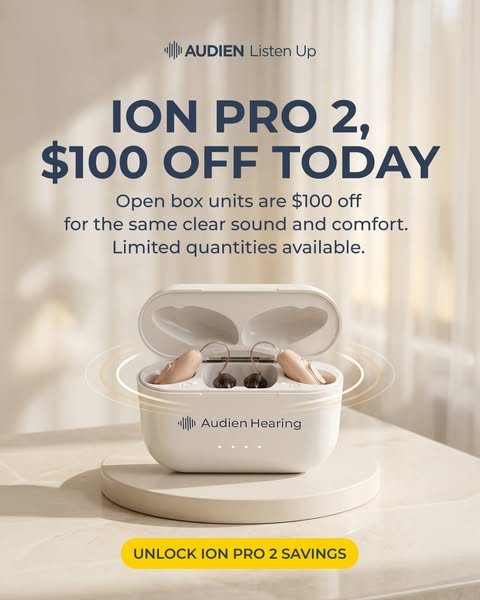
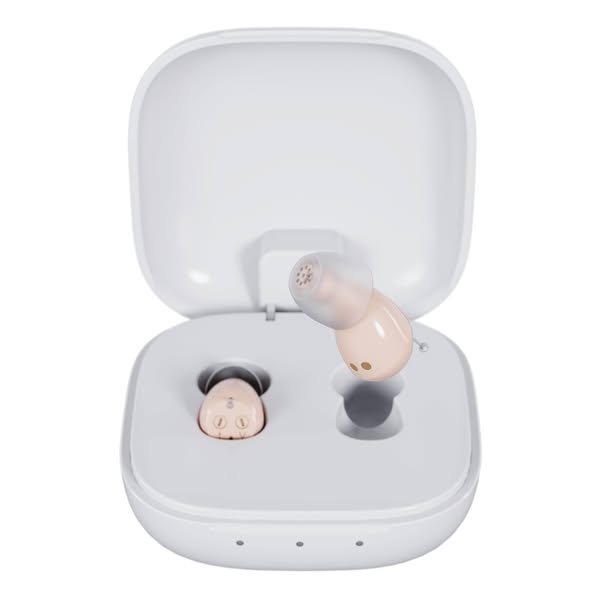
"Join 1,000,000+ people who trust Audien… The Atom One is: 🤫 Nearly invisible (ITE design)…"
"Introducing the Atom X: the world's first hearing aid with a touchscreen." · "Upgrade to the ION Pro 2 — new A2 MAX Sound Chip."
"And a waiting room" is the line to steal. It turns Clarion's no-clinic model from a feature into a cost the competitor is charging you. Note also the named product launches — Atom One, Atom Air, Atom X, ION Pro 2 — which buy a fresh ad every quarter without needing a new argument. ⛔ Do not copy the million-customer proof: Clarion cannot claim it and must not fake it.
Hear Direct Club, live 296 days: "Tired of those cheap 'amplifiers' that promise the world but just end up in a drawer? You're not alone."
Hear Direct Club: "Traditional hearing aids are stuck in the past — they're just volume knobs that make everything louder. Background noise, conversations, kitchen sounds…"
"Say goodbye to jingling keys, humming fridges, and embarrassing whistles."
Clarion sits between $50 chemist amplifiers and $5,000 clinic pairs, so it has two enemies, not one. Every ad above only attacks the expensive side. The cheap side is unguarded — and "it ended up in a drawer" is a memory most of this audience already has.
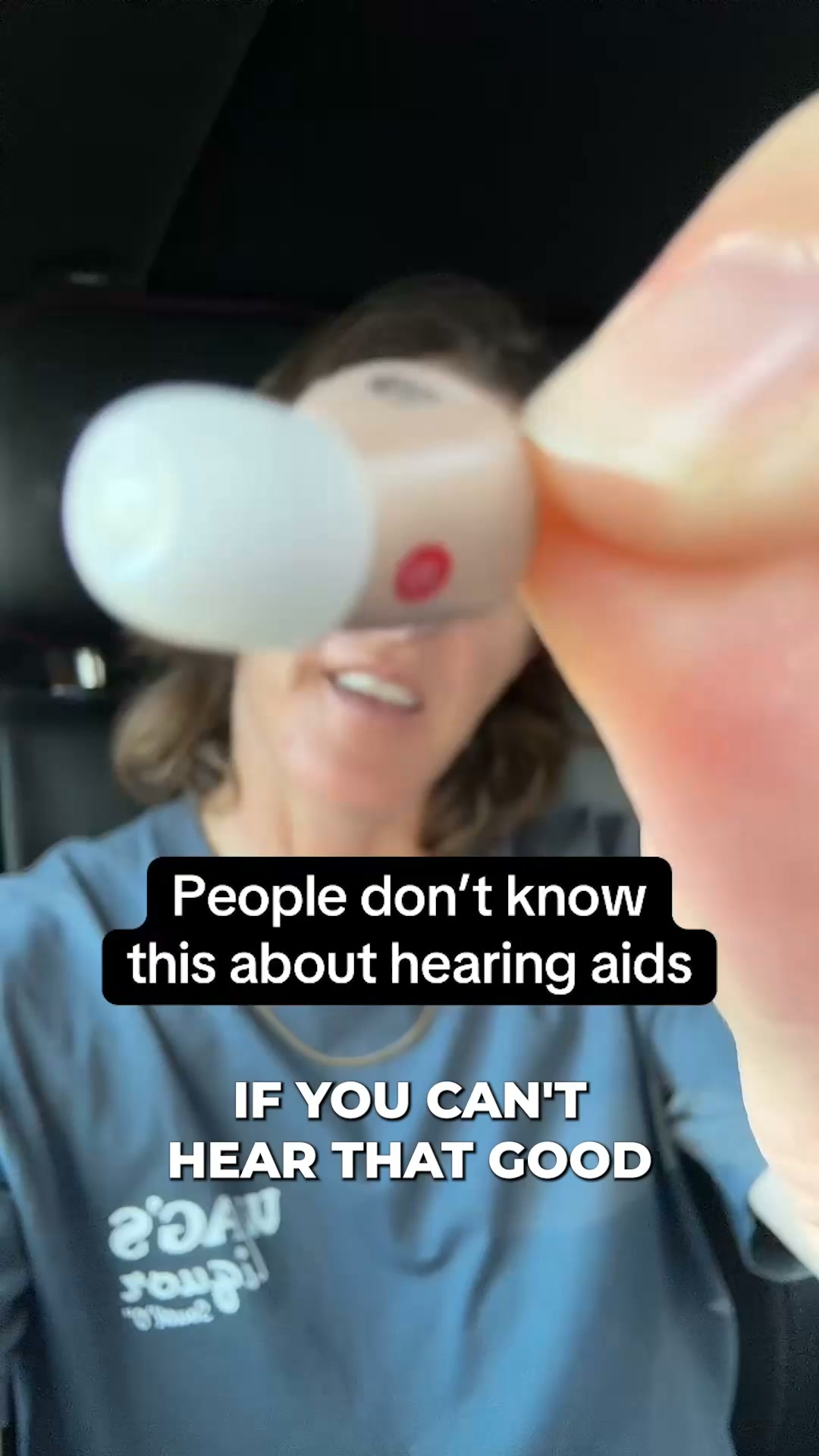
"I've had 9 pairs of hearing aids in the past decade and out of them all, these bluetooth ones are the best. Let me explain…"
"These hearing aids are smaller than the tip of your pinky finger, yet they pack 15 powerful features."
"Based on the hearing aids that went viral in 2023, these are improved with app control."
Authority from experience, not credentials. Clarion can never out-credential Hearing Australia or Specsavers — but "I've worn nine pairs" is an authority a clinic cannot buy, and it is available to any genuine customer Clarion already has. Pair it with a physical size comparison, which is the one product claim that photographs well on a phone.
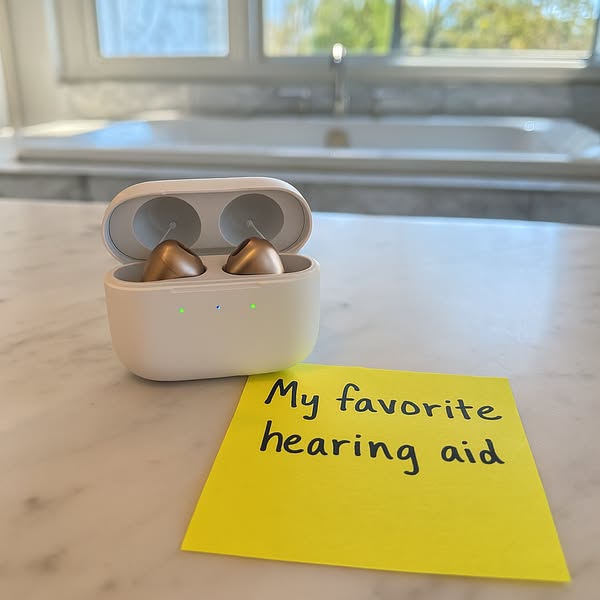
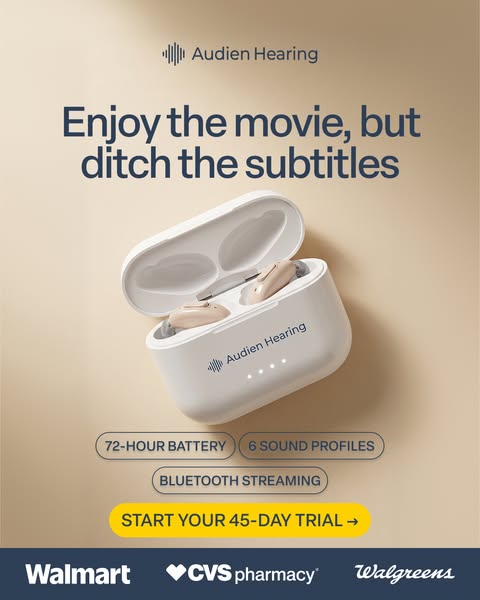
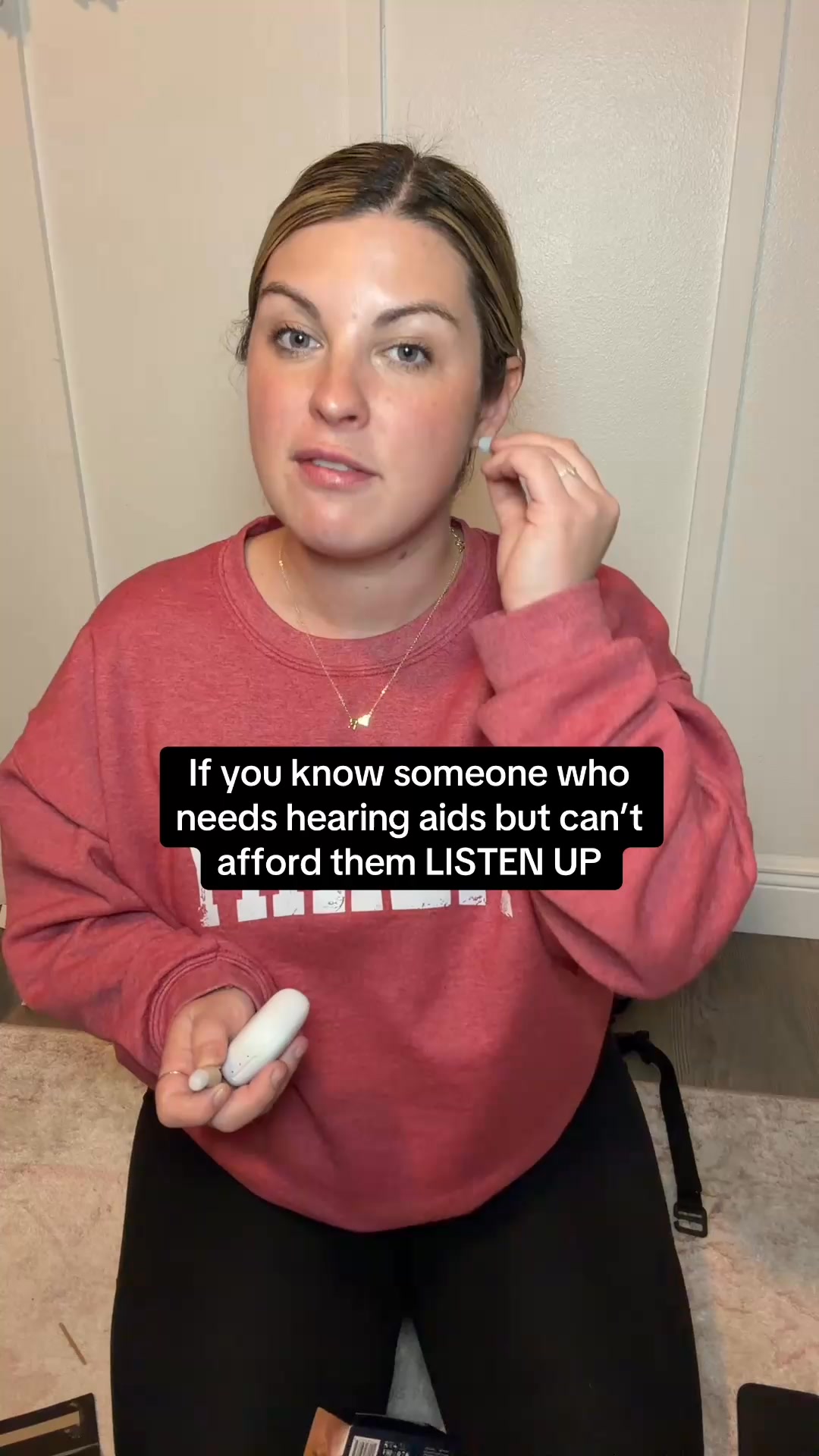
What America proves that Australia does not. Selling a hearing aid online, at a named price, with no appointment and no eligibility gate, is a proven model — the ads doing it have run 296 and 370 days. It simply is not proven in Australia yet, because almost nobody here is trying it. That is the opportunity, not the risk.
Four instructions, in order.
Give the agency these in writing, before they script anything.
The approved claims are 3 year warranty and 90 day trial. The existing founder video says 5 years and 100 nights. If the agency uses it as reference they will shoot false warranty claims onto camera. That same video also says "Puretone" twice — send them the brand name spelled out.
The customer list never leaves Clarion. If they want testimonials, Clarion makes the introduction. There has already been one bulk email with 12 buyers in the To: field instead of BCC.
[CLINIC QUOTE] must be a real, sourced quote. Five of the seven hooks lean on it — get a genuine clinic quote in writing (details blurred, total visible) before any of them shoot. And confirm delivery coverage before any cut promises "to your door" in a named town.
Nothing on this page is safe to copy word for word. Meta removed one advertiser's ad outright in this category for breaching Advertising Standards. "Eligible", "qualify", "free trial" and compensation claims all carry ACL and TGA exposure if the underlying offer isn't real. Copy the mechanics; write your own words.